
When introducing a medical device to the market, generating strong clinical evidence is critical. However, expectations for this evidence differ depending on the regulatory framework and region.
While 510(k) clearance often relies on a combination of pre-market clinical data, substantial equivalence, and post-market monitoring, the EU MDR places a much stronger emphasis on continuous clinical evaluation and demonstration of a favourable benefit–risk profile in relation to the state of the art (SOTA).
As a result, FDA clearance alone is not sufficient for European market access. Success depends on strategically aligning existing clinical data with EU MDR expectations, ensuring that all evidence is systematically evaluated, justified, and clearly documented within the Technical Documentation to support CE marking.
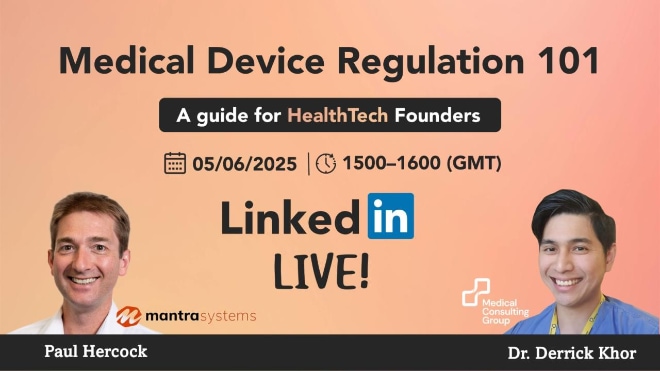
We recently hosted a collaborative webinar with Measurlabs where we discussed how device manufacturers with FDA clearance can repurpose their existing preclinical and clinical data for EU MDR purposes. Mantra Systems discussed the importance of clinical evidence and how clinical data from your FDA submission can be repurposed for EU MDR submissions. See the video below to tune in. We are excited to offer a FREE 1:1 FDA to MDR strategy planning session to aid device manufacturers in leveraging existing FDA clinical evidence to demonstrate EU MDR compliance.
Our 26th March 2026 webinar: Streamlining EU MDR approval - Re-using your FDA preclinical and clinical data
Technical Documentation under EU MDR
Under the EU Medical Device Regulation (EU) 2017/745, manufacturers must maintain Technical Documentation demonstrating compliance with regulatory requirements and the General Safety and Performance Requirements (GSPR) outlined in Annex I. This documentation provides evidence that the device is safe, performs as intended, and offers a favourable benefit–risk profile.
Key foundations include:
- Clinical evaluation
- Risk management
- Post-market surveillance
Together, these elements demonstrate that the device consistently achieves its intended benefit while maintaining acceptable safety throughout its lifecycle. For US manufacturers, the clinical evaluation often the most significant area requiring adaptation.
Why Clinical Evaluation is Critical under EU MDR
Clinical evaluation is a systematic and planned process used to demonstrate that a medical device:
- Achieves its intended clinical benefits
- Demonstrates clinical performance as intended
- Is safe for its intended purpose
- Maintains an acceptable benefit–risk ratio
The intended purpose of the device directly informs the clinical evidence requirements, which in turn provides robust evidence that the device meets the performance and safety expectations under the EU MDR. The clinical evaluation is ongoing throughout the device lifecycle, not a one-time pre-market activity (MDCG 2020-6).
Three core documents structure the clinical evaluation process:
| Document | Purpose |
|---|---|
| State-of-the-Art (SOTA) Review | Evaluates current clinical practice and available treatment options to establish benchmark safety and performance standards. SOTA reflects the accepted gold-standard treatment in clinical practice. |
| Clinical Evaluation Plan (CEP) | Defines how the clinical evaluation will be conducted, including the literature search strategy, data sources, inclusion/exclusion criteria, and data appraisal methods. |
| Clinical Evaluation Report (CER) | Integrates all available clinical evidence to demonstrate that the device meets regulatory requirements for safety, performance, and benefit–risk acceptability in relation to its intended purpose. |
EU MDR Clinical Evidence Requirements
Under EU MDR (2017/745), clinical evaluation demonstrates that a device’s benefit–risk profile aligns with current SOTA treatments. Unlike the FDA, clinical evidence is required for all device classes to support safety, performance, and any clinical claims. Manufacturers must ensure all clinical benefit claims are backed by robust evidence.
Leveraging Existing FDA Clinical Data
For US manufacturers, existing FDA clinical data can provide a strong foundation for EU MDR compliance. However, this data must be carefully assessed, structured, and documented to meet EU MDR requirements.
Repurposing FDA clinical data can be approached systematically through the following strategy:
- Determine the Device's Intended Purpose
- Identify EU MDR Clinical Evidence Requirements
- Map FDA Submission Data to EU MDR Requirements
- Perform a Clinical Evidence Gap Analysis
-
Address Gaps
- Conduct new clinical studies (if needed)
- Demonstrate equivalence to a CE-marked device
- Use additional literature, registries, or real-world data
Manufacturers with FDA clearance often have significant amounts of clinical data that can be repurposed for EU MDR compliance if evaluated and documented appropriately. Common sources include:
Common sources of reusable clinical data include:
- Clinical investigations conducted by the manufacturer
- Independent peer-reviewed literature
- Real-world evidence (RWE)
- FDA post-market surveillance data
Clinical Investigations Conducted by the Manufacturer
Under Article 61(4) of the EU MDR (EU) 2017/745, clinical investigations are generally required for Class III and implantable devices, unless sufficient clinical evidence already exists.
High-quality clinical studies should evaluate:
- All device variants
- Intended indications
- Target patient populations
- User populations (e.g. healthcare professionals)
- Duration of treatment effect
In some cases, manufacturers may demonstrate safety and performance without new clinical investigations if adequate existing data are available. Studies conducted according to ISO 14155:2020 provide strong supporting evidence for regulatory submissions.
Independent Scientific Literature
Published, peer-reviewed studies involving the subject device, such as randomised controlled trials (RCTs), can contribute to clinical evidence requirements under EU MDR. Manufacturers are required to critically appraise all relevant clinical data to determine whether each dataset adequately demonstrates the device’s safety and performance (MDCG 2020-6).
This involves assessing:
- Study design
- Methodology
- Relevance of the data to patient populations
- Clinical endpoints and outcomes
- Safety and performance data
In other words, the manufacturer must assess the quality of each dataset and justify its acceptability in relation to the device’s intended purpose, claimed clinical benefits, and associated risks.
Real-World Evidence (RWE)
Real-world evidence plays an increasingly important role in the EU MDR clinical evaluation. RWE reflects device performance and safety in routine clinical practice across diverse patient populations and healthcare settings. Unlike controlled clinical trials, RWE studies typically:
- Continue indefinitely through registries or observational databases
- Capture long-term safety and performance data
- Include varied clinical settings and user populations
RWE studies generally do not have strict inclusion/exclusion criteria, fixed recruitment numbers, or limited study timeframes. Despite these differences, RWE provides valuable insights into the real-world effectiveness, safety, and performance of a device, continually adding new subjects to the dataset and reflecting experience across all patient and user populations normally exposed to the device.
FDA Post-Market Surveillance Data
Post-market surveillance (PMS) data collected from the US market can support EU MDR requirements for clinical evidence.
Examples include:
- Complaints data
- Field corrective actions
- Serious incident reports
- Sales and distribution data
These datasets provide valuable information about device performance and safety in real-world clinical environments and may support the overall benefit–risk assessment of the device.
| Requirement | FDA | EU MDR |
|---|---|---|
| PMS Focus | Focus on complaint handling, Medical Device Reports, recalls | Mandatory for all classes; Continuous clinical evidence generation |
| Post-market clinical follow-up | Not mandated unless required by FDA (E.g. post-approval studies) | Mandatory for most Class IIa devices and above |
| Periodic safety update report/ Summary | Annual report for some PMA devices | Required for Class IIa devices and above; frequency depends on device risk class |
Identifying Clinical Evidence Gaps
Even when extensive FDA data is available, manufacturers must determine whether their existing evidence adequately supports EU MDR requirements. This involves evaluating:
- How device outcomes compare with State-of-the-Art clinical practice
- Whether patient populations differ between the US and EU
- Whether all clinical claims are supported by robust evidence
A clinical evidence gap analysis is therefore an essential step in the EU MDR transition process.
Addressing Evidence Gaps
When gaps are identified, manufacturers may need to generate additional evidence through one or more approaches:
- Conducting a new clinical study (often necessary for Class III and implantable devices)
- Demonstrating equivalence to an existing CE-marked device
- Leveraging additional literature registry data, or preclinical evidence.
Selecting the appropriate strategy depends on device classification, available evidence, and the specific claims being made. By comparing your device’s performance and safety data to current SOTA benchmarks and ensuring the data reflects appropriate patient/user populations and intended use, you can determine what evidence can be repurposed for EU MDR submissions and identify where additional data may be needed.
Conclusion
For US manufacturers, entering the European market under the EU MDR 2017/745 does not require starting from scratch. Existing FDA clinical data can provide a strong foundation for EU MDR compliance. However, this data must be carefully structured within the EU MDR clinical evaluation framework, supported by a robust State-of-the-Art (SOTA) review, and integrated into the Technical Documentation appropriately.
By systematically assessing clinical evidence and addressing gaps early, manufacturers can streamline their path to CE marking whilst ensuring ongoing demonstration of device safety and clinical performance.
Want to explore how you can leverage your FDA clinical data for EU MDR requirements? Book a FREE 1:1 FDA to MDR strategy planning session with us today. We can help you streamline your FDA submission to ensure EU MDR compliance.