
On 16 December 2025, the European Commission published a landmark legislative proposal (COM(2025) 1023 final) introducing targeted amendments to Regulation (EU) 2017/745 (MDR) and Regulation (EU) 2017/746 (IVDR).
The aim of the proposal is to simplify regulatory procedures, reduce unnecessary administrative burden, and improve predictability for manufacturers and regulators, while maintaining the high standards of patient safety and public health established under the current medical device framework.
Why have these changes been proposed?
In our previous article, we outlined the proposed regulatory changes and their rationale. In this article we take a closer look into the proposed amendments set out by the European Commission’s proposal, unpacking its proposed changes step by step.
Despite the enhanced safety and performance requirements introduced by the MDR and IVDR, implementation has remained challenging. Limited notified body capacity, prolonged conformity assessment timelines, and inconsistent interpretation across Member States have constrained device availability, innovation, and competitiveness particularly for SMEs and manufacturers of niche, low-volume products ie. custom implants, orphan medical devices.
Although the MDR has applied since 26th May 2021 - with the IVDR following on 26th May 2022 - only 51 MDR and 19 IVDR notified bodies have been designated to date. This is a somewhat limited number given the estimated 23,000 certificates that must be issued. Stricter requirements, especially for legacy devices, combined with limited certification capacity and variable manufacturer preparedness, have increased the risk of supply shortages and withdrawal of critical devices.
Transitional provisions were extended under Article 120 of the MDR and Article 110 of the IVDR (Regulations (EU) 2022/112), Regulation (EU) 2023/607 and Regulation (EU) 2024/1860), easing immediate supply pressures. However, these measures did not address underlying structural challenges, issues that the current amendments aim to resolve in a systemic and sustainable manner.
Key Elements of the Commission’s Proposal:
Topic 1: Simplification And Proportionality
Person Responsible for Regulatory Compliance (PRRC)
The proposal will remove the detailed qualification requirements for the PRRC. SMEs will no longer be required to have PRRC “permanently and continuously” available, only “available”.
Validity of certificates and recertification
The proposal will remove the 5-year maximum validity period for certificates. Notified Body recertification will be replaced with periodic reviews proportionate to the device risk class.
Clinical evidence, non-clinical data and clinical data
The proposal will broaden the definition of “clinical data” to allow manufacturers to rely on a wider range of data, including scientific literature and non-clinical data such as in silico testing, to confirm safety and performance. More flexible conditions will be introduced for demonstrating equivalence to other devices, including the removal of the requirement for a contract with the equivalent device’s manufacturer. The proposal will also promote the use of “New Approach Methodologies” (NAMs) to reduce animal testing.
Well-established technologies
Under the proposed changes, a formal definition will be introduced for devices with simple, stable designs and a long history of market use. These devices will benefit from proportionate regulatory requirements and certain exemptions.
Repackaging and relabelling
Under the Commission’s proposal, the requirement for a Notified Body certificate and prior notification obligations for relabelling and repackaging activities will be removed.
Classification rules
The proposal reclassifies certain devices to lower risk classes (e.g. reusable surgical instruments, accessories to active implantables, and certain software).
Topic 2: Reduction Of Administrative Burden
Summary of safety and (clinical) performance
The Scope of SSCP will be reduced to devices requiring systematic technical documentation assessment. Separate notified body validation will no longer be required, as the SSCP is already part of the submitted documentation.
Periodic Safety Update Report
The proposal will reduce the reporting frequency of the PSUR: for Class IIb and III devices, submission will be required in the first year and then every two years; for Class IIa devices, submission will be required only “when necessary.” Notified Body review will be integrated into routine surveillance activities.
Reporting timeline of certain serious incidents in the framework of vigilance
Reporting timelines will be extended to 30 days (from 15 days) for serious incidents that do not involve death, serious deterioration of health, or a serious public health threat.
Changes after certification
Notified Bodies will be required to distinguish between changes to the quality management system or the approved device that manufacturers may implement without prior notification, without prior approval, or only after approval by the Notified Body. The proposal introduces predetermined change control plans agreed between the manufacturer and the Notified Body.
Authorisation or notification of certain performance studies
Routine blood draw studies will be exempt from prior authorisation. The notification requirement will be removed for companion diagnostic performance studies using left-over specimens.
Topic 3: Innovation And Availability Of Devices For Special Patient Groups Or Situations
In-house devices
More flexible conditions will be introduced for the manufacture and use of in-house devices within health institutions. The proposal will permit the transfer of in-house devices between health institutions where justified for patient safety or public health reasons. For IVDs, the condition requiring the absence of an equivalent device on the market will be removed. The exemption will be extended to laboratory-developed tests used exclusively in clinical trials.
Interruption or discontinuation of supply of certain devices
A central IT tool for reporting and information exchange will be provided within or interoperable with EUDAMED. The EMA will define the methodology and list of devices subject to reporting.
Conformity assessment procedures for breakthrough devices or orphan devices
Formal definitions and eligibility criteria will be introduced. Priority review pathways, including rolling reviews, would be established. Expert panel designation and scientific advice will be made available. Certificates could be issued based on limited clinical data where the benefit outweighs the risk. Mandatory fee reductions will be introduced for orphan devices.
Derogations for public health emergencies, disasters or crises
The Commission will be empowered to authorise devices during public health emergencies without full conformity assessment. Competent authorities may grant exemptions during serious cross-border health threats, disasters, or crises.
Regulatory sandboxes
Member States and the Commission will be able to establish regulatory sandboxes for emerging technologies, allowing temporary waivers of certain regulatory requirements under strict supervision.
Reprocessing of single-use devices
Manufacturers will be required to justify the designation of devices as single-use. Devices not intended for single use could be reprocessed in accordance with the manufacturer’s instructions. Full refurbishment of single-use devices will establish a new manufacturer relationship. These provisions will apply five years after entry into force.
‘Grandfathering’ of legacy orphan devices
Legacy devices meeting orphan device criteria will be permitted to remain on the market beyond transitional periods, subject to defined conditions.

Topic 4: Predictability And Cost-Efficiency Of Certification
Structured dialogue
A legal basis will be established for documented pre- and post-submission dialogue between manufacturers and Notified Bodies.
Conformity assessment procedures
Notified Body involvement will be reduced for Class IIa and IIb medical devices and Class B and C IVDs. Technical documentation assessment will be limited to one representative device per generic device group or category. Systematic technical documentation assessment during surveillance will be removed. Class A sterile IVDs will no longer require Notified Body involvement. Remote audits could be conducted in place of on-site audits. Surveillance audits will be required every two years, where justified. Unannounced audits will be conducted “for cause” only.
Clinical Evaluation Consultation Procedure (CECP)
The scope will be limited to Class III implantable devices only, with the possibility for the Commission to add further device types through delegated acts.
Performance Evaluation Consultation Procedure (IVDR)
The procedure will be removed entirely and replaced by early scientific advice from expert panels for Class C and D IVDs.
Notified body fees
Mandatory fee reductions will be introduced: at least 50% for micro-enterprises, at least 25% for small enterprises, and at least 50% for orphan devices. The Commission will be empowered to set fee levels and fee structures.
Topic 5: Coordination Within Decentralised System
Regulatory status of products and classification of devices
The “Helsinki procedure” would be codified to strengthen coordination among competent authorities. Expert panel opinions would be made available for borderline and classification disputes, alongside a clear dispute resolution mechanism between manufacturers and Notified Bodies.
Designation and monitoring of notified bodies
The designation process would be streamlined through joint assessment teams composed of national authorities, the Commission, and experts from other Member States. These teams will also be involved in Notified Body monitoring at least every two years. The requirement for full reassessment every five years would be removed.
Dispute resolution mechanism between manufacturers and notified bodies
The authority responsible for overseeing the Notified Body would act as an “ombudsperson” to facilitate resolution of disputes.
Coordination of notified bodies
The obligation for Notified Bodies to participate in the Notified Bodies Coordination Group (NBCG-Med) would be strengthened. NBCG-Med would report to the Medical Device Coordination Group (MDCG).
Enhanced role of external expertise available to the regulatory system
The scope and composition of external expert groups would be expanded to provide scientific, clinical, technical, and regulatory advice. The EMA would continue to act as the secretariat.
Support from the EMA for the coordination of competent authorities
A new mandate would be introduced for the EMA to support coordination among national competent authorities, including in areas such as borderline and classification issues, multi-country clinical studies, derogations, vigilance, and market surveillance. An SME support scheme would also be established.
Topic 6: Further Digitalisation
Digitalisation of compliance tools
The EU Declaration of Conformity would be issued in digital format. Label information could be provided digitally, subject to implementing rules. Electronic instructions for use would be permitted for near-patient tests. All submissions under the MDR and IVDR would need to be made electronically. Economic operators would be required to provide digital contact details in EUDAMED.
Digitalisation of conformity assessment
Technical documentation, assessment reports, and other regulatory documents could be submitted in digital, machine-readable formats with appropriate version control.
Online sales
Essential device information and instructions for use would be made available for devices sold online.
UDI and EUDAMED
Provisions relating to UDI and EUDAMED would be clarified. Certain electronic systems could operate outside EUDAMED, provided they are interoperable.
Topic 7: International Cooperation
International cooperation and reliance mechanisms
The proposal promotes global regulatory convergence, including alignment with IMDRF and MDSAP. The Commission may enter into administrative arrangements with third countries. Reliance mechanisms would allow recognition of conformity assessments and inspections performed by foreign regulatory authorities.
Topic 8: Interplay With Other Union Legislation
Combined studies involving medicinal products, medical devices and/or IVDs
A single application process would be introduced for studies involving medicinal products, medical devices, and/or IVDs, with coordinated assessment under the Clinical Trials Regulation.
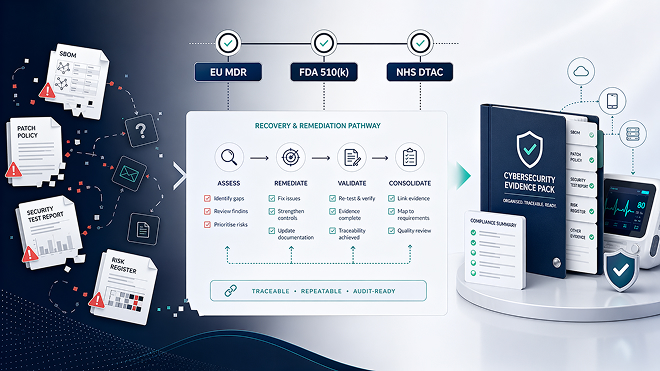
Cybersecurity
Serious incidents qualifying as actively exploited vulnerabilities would need to be reported to CSIRTs and ENISA via EUDAMED. Manufacturers would also require reporting vulnerabilities and cybersecurity incidents that do not meet the definition of a serious incident.
AI Act
Medical devices and IVDs regulated under the MDR and IVDR would be moved from Section A to Section B of Annex I of Regulation (EU) 2024/1689. This would limit the application of the AI Act to specific provisions for these products.
What’s next for manufacturers?
While the core MDR and IVDR frameworks remain unchanged, the proposed amendments signal a move toward a more proportionate, predictable, and innovation-friendly regulatory environment.
The European Commission’s proposal has been submitted to the European Parliament and Council of the EU for review and remains subject to change during the legislative process.
An 8-week feedback period has been opened, ending 30 March 2026, allowing interested parties to comment on the proposal. Feedback will be shared with the European Parliament and the Council and will inform the legislative debate.
Need clarity on what these changes mean for your devices? Talk to our experts today.