
The transition from the Medical Device Directive (MDD) to the Medical Device Regulation (MDR) represents a significant shift in the regulatory landscape for medical devices within the European Union (EU).
The MDD provided a regulatory framework to govern the safety and performance of medical devices within the EU market. It was designed to ensure that medical devices, from simple products like bandages to more complex technologies such as pacemakers, met stringent safety and performance standards before entering the market. The introduction of the EU MDR replaces the MDD and the Active Implantable Medical Devices Directive (AIMDD), introducing a more rigorous and comprehensive regulatory approach.
The EU MDR requires the demonstration of equivalence to be more transparent and supported by more evidence. Furthermore, the process of establishing equivalence necessitates careful preparation and comprehensive documentation due to the MDR’s unique criteria and enhanced scrutiny.
Unlocking the Concept of Equivalence
Equivalence refers to the process of demonstrating that a new device is as safe and effective as an already existing, previously approved device. This comparison is made in terms of several critical factors, including the device’s intended use, design, principles of operation, and clinical performance. Essentially, proving equivalence involves showing that the new device performs in a similar way to the predicate device, ensuring that it does not introduce any additional risks or hazards for the patient or user.
Under the MDR (Annex XIV, Part A), manufacturers are required to consider a comprehensive range of technical, biological, and clinical characteristics when demonstrating equivalence. These characteristics are fundamental to the assessment process and must be thoroughly evaluated to confirm that the new device meets the same safety and performance standards as the existing device. The MDR outlines specific expectations for each of these areas, with the requirement for robust documentation and evidence to support equivalence claims.
The guidelines set forth in the MDCG 2020-5 document offer further clarity on how to assess these three key characteristics. The guideline underscores the need for clear, scientific evidence and detailed justifications when manufacturers claim equivalence, ensuring that the new device is not only technically comparable but also demonstrates equivalent clinical performance in real-world settings.
Technical characteristics
Under the MDD, both the subject device and its equivalent must be used in the same conditions of use. In contrast, the MDR only mandates that the conditions of use be similar. If there are no significant differences expected in terms of safety and performance, the conditions of use can be considered similar.
The MDR also introduces a specific requirement for software algorithms, stating that the algorithms of the subject device and its equivalent must be similar. This includes software algorithms that drive or influence the use of the device, as well as software intended for standalone use, which was not something explicitly required under the MDD. When establishing equivalence for a software algorithm, factors such as its functional principle, clinical performance, and intended purpose are all taken into account.
Biological characteristics
Both the MDD and MDR require the use of the same materials or substances that come into contact with the same type of human tissue or body fluids. However, the MDD allowed for some flexibility, particularly when it comes to devices that are in contact with intact skin or contain minor components. In these cases, risk analysis results may permit the use of similar materials, considering the role and nature of the material in the device.
In contrast, the MDR introduces more specific and stringent requirements. It mandates that materials used in devices must exhibit similar release characteristics, such as leachable and degradation products, compared to the equivalent device. Additionally, these materials must be used under similar conditions, such as the same type of contact, and for a similar duration. Furthermore, the MDR imposes extra obligations when it comes to substances intended for introduction into the human body, whether they are absorbed or locally dispersed. In such cases, equivalence must be demonstrated by using the same substances, ensuring that safety and performance standards are met across the board.
These devices are not medicinal products, but they must meet the requirements in Annex I of Directive 2001/83/EC17 for conformity assessment. This includes evaluating how they are absorbed, distributed, metabolised, and excreted, as well as their local tolerance, toxicity, interactions with other devices, medicines, or substances, and potential adverse reactions. These factors must also be considered when proving equivalence under the MDR.
Clinical characteristics
The MDR specifies that the device must be used by the same type of user, whether that’s a healthcare professional or a layperson. When making an equivalence claim, manufacturers are required to assess whether the skills and knowledge of the intended user might influence the safety, performance, or clinical outcomes. For example, a portable oxygen concentrator designed for hospital use may have advanced features, such as precise flow control and continuous monitoring, to meet the needs of medical professionals. On the other hand, a home-use oxygen concentrator is simpler, offering basic functionality for patients with respiratory conditions, designed for ease of use without the need for professional intervention, and likely with fewer advanced features.
While the MDD clearly states that the medical devices being compared must be used for the same medical indication and duration, the MDR presents a more flexible requirement, stating that devices must be used “for the same clinical condition of the patient or for the same purpose.” Both the MDD and MDR, however, ensure that devices address a similar severity and stage of disease, while also demonstrating comparable critical performance characteristics.
Winning Strategies for MDR Equivalence Claims
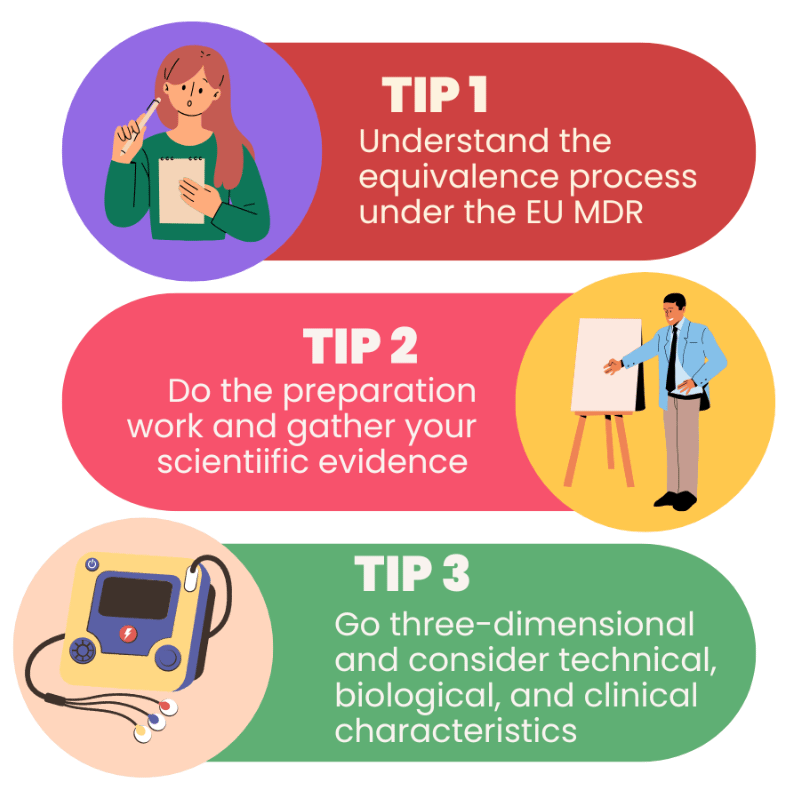
Tip 1: Understand the process
Equivalence is the process of demonstrating that two or more devices are similar to the point that there is no clinically relevant difference in their safety and clinical performance. In other words, it’s much more than just showing they are ‘similar’. Equivalent means ‘effectively the same as’, meaning that it’s harder to prove than a claim of similarity.
Tip 2: Do the prep work
According to MedDev 2.7/1 rev 4, equivalence claims should be backed up with strong scientific evidence. This may require an extensive literature search to address the device’s technical, biological, and clinical specifications.
The medical device manufacturer should identify and declare any differences between the two devices that are revealed during the literature appraisal – don’t shy away from them. Conducting a Gap Analysis to see whether there is a clinically relevant difference between your product and the proposed equivalent device will also help you to flesh out the equivalence claim.
Watch our guide on equivalence in medical devices
Tip 3: Go three-dimensional
The three dimensions to be taken into consideration while demonstrating equivalence are technical, biological, and clinical characteristics of the devices. Having done the prep work, it’s time to form the argument.
Key tips for a robust equivalence claim
Under the new regulations, the process of equivalence is more rigorous, demanding robust clinical evidence, detailed documentation, and a proactive approach to post-market surveillance. These changes are designed to ensure that medical devices continue to meet the highest standards of safety and effectiveness, ultimately benefiting patients.
For manufacturers, understanding and navigating these changes is essential to successfully demonstrate equivalence and ensure compliance with the MDR. As the regulatory landscape evolves, companies must be prepared to adapt their processes and enhance the quality of their evidence to maintain market access and meet the growing expectations of regulatory authorities and patients alike.
If you’re looking to navigate the complexities of MDR equivalence claims, our team is here to help. Contact us today to learn how we can support your regulatory journey and ensure compliance with the latest MDR requirements.