
Is outside consulting support the answer to your MDR transition?

Paul Hercock
Use medical device regulatory consulting services to supercharge your MDR transition

Getting ready for the MDR is a demanding process. Whether you are upgrading your existing regulatory structures to the new MDR standard or building fresh systems for a new device, meeting the demands of the MDR can be a challenge even for experienced regulatory specialists.

Video: How to build an EU MDR compliance strategy for your medical devices

Much of the challenge, however, comes not just from the work itself. The sheer volume of work required means that regulatory departments can feel severely under-resourced. So much time is required for every individual work element that it is commonplace for regulatory departments to exceed capacity and become entirely overwhelmed.

This can be a difficult problem to solve because there may be a recognition amongst management that the issue is temporary — once systems have been updated to the MDR standard, workload can be expected to reduce as it focuses more on maintenance than re-engineering. Coupled with a shortage of regulatory specialists in the marketplace, this makes permanent additional recruitment difficult in many cases.

The answer

The answer is to bring in outside consulting support. Expert medical device regulatory consulting services give you MDR specialists who will help facilitate your MDR transition. By their nature, consulting services are intended to step in when needed and then to step away, making it an efficient and cost-effective way of meeting MDR transition requirements without needing to permanently expand your regulatory department. More and more medical device manufacturers are looking to specialist medical device consulting providers for the support they need during their MDR transition.

At Mantra Systems, we go beyond standard regulatory consulting. We have a team of dedicated and specially trained MDR-experts who are also clinically-trained medical professionals. This unique blend of skills means that our consultants combine MDR & regulatory expertise with the clinical acumen needed to meet MDR requirements for clinical evidence generation, appraisal and analysis. Whether it’s writing Clinical Evaluation Reports, designing and implementing PMCF studies & surveys, performing systematic evidence analysis or working with medical device software (SaMD), our team can help.

Contact us today to start your MDR transition.

Related articles

  1. US and EU flags on poles alongside each other.


    Clinical Evidence under EU MDR: Leveraging FDA Clinical Data to Streamline EU MDR Compliance

    FDA approval alone is not sufficient for European market access - a theme we explore futher in this article and the accompanying webinar.

    Chandini Valiya Kizhakkeveetil Chandini Valiya Kizhakkeveetil Regulatory Medical Writer
  2. An AI-generated image of 3 people in an office in front of a whiteboard with the words 'Medical Device Market Entry Strategy' written above a world map.

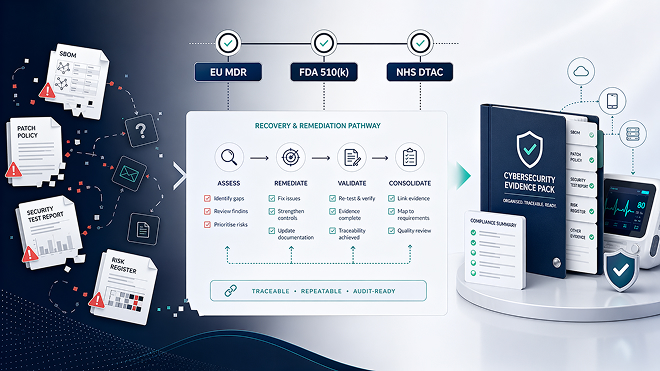
    EU MDR & NHS DTAC Cybersecurity Requirements for UK Market Entry

    This guest article from our partner Cyber Alchemy shows you how to build cybersecurity evidence for the EU MDR and NHS DTAC.

    Luke Hill Luke Hill Co-Founder of Cyber Alchemy
  3. An illustration showing a GPS-driven navigation route superimposed upon someone using a laptop.

    Where to Launch First? A MedTech Founder's Regulatory Roadmap to the EU, UK and US

    Cyber Alchemy × Mantra Systems — Episode 1: All three markets operate under different regulatory systems and place different demands on manufacturers.

    Ronghe Xu Ronghe Xu Regulatory Medical Writer & Strategic BD Lead China
  4. A woman uses an inhaler.

    Navigating EU MDR Article 117: A Practical Guide to Drug-Device Combination Product Submissions

    Implementation of the EU MDR 2017/745 has brought significant changes.

    Chandini Valiya Kizhakkeveetil Chandini Valiya Kizhakkeveetil Regulatory Medical Writer
  5. Collage art showing a pair of binoculars, an analogy for surveillance.

    How EU MDR Post Market Surveillance differs from FDA post-market expectations

    We compare manufacturer-specific post-market obligations across both regulatory systems.

    Dr Gayle Buchel Dr Gayle Buchel Chief Medical Writer
  6. An arrow arcs from the US over to Europe.

    How EU device classification differs from the US - Are you Prepared?

    Did you know an FDA Class II medical device could be immediately considered as a high-risk Class III device under European Union regulations?

    Gabriela Cardoso Gabriela Cardoso Regulatory Medical Writer
  7. A magnifying glass inspecting a number of wooden cubes with question marks upon them laid upon a blue table. The wooden cube under the magnifying glass has a lightbulb painted on it.

    Fixing the MDR and IVDR? The Commission’s Proposed Amendments and What They Mean for Manufacturers

    Exploring the key elements of this proposal.

    Chandini Valiya Kizhakkeveetil Chandini Valiya Kizhakkeveetil Regulatory Medical Writer
  8. Two arms point at a sign and hold a question mark, in an abstract pop-art style.

    Regulatory Reset? The EU’s Proposed Changes to MDR and IVDR Explained

    Changes published in December 2025 aim to streamline EU medical device and in vitro diagnostics. We explain who is impacted and how.

    Dr Gayle Buchel Dr Gayle Buchel Chief Medical Writer
  9. A pair of glasses rests on an eye test chart.

    Did You Know Your Glasses Were a Medical Device? A Regulatory Guide for Manufacturers

    The importance of correct classification and our recommended path to avoid common ophthalmic device 'gotchas'.

    Gabriela Cardoso Gabriela Cardoso Regulatory Medical Writer

More articles

Need help producing compliant CEPs & CERs? We are offering FREE CEPs to 5 qualifying applicants per week

Get your free CEP