EU MDR, FDA 510(k) and DTAC Cybersecurity Nonconformities: How to Recover

Neil Richardson
  • By Neil Richardson
  • Co-Founder of Cyber Alchemy
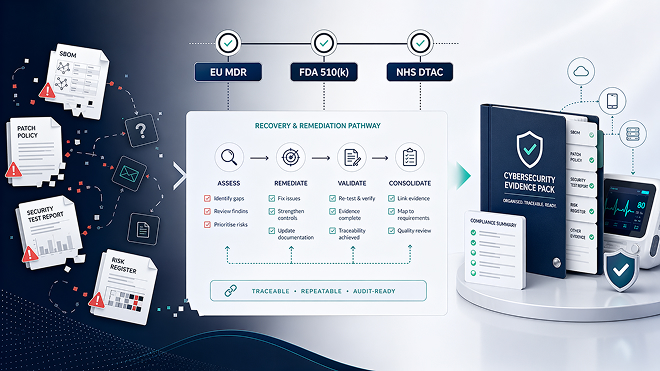
A process flow leading to a cybersecurity evidence pack

You had a clinical idea that could genuinely help people. Cybersecurity wasn’t part of the plan. That’s understandable. It’s also where things go wrong.

You didn’t start this because you wanted to spend months arguing about patch policies and evidence chains. You started it because you saw something in clinical practice that could be done better, a gap, a risk, a way of helping patients that the current system wasn’t delivering. That’s a good reason to build a medical device. It’s also, if we’re being straight with you, the reason most founding teams arrive at cybersecurity late.

Not because they ignored it. Because they were focused on the thing that actually matters, the clinical problem and cybersecurity felt like an administrative layer to deal with later. Then, later arrived. And it was harder, and more expensive, than anyone had budgeted for.

We’ve seen this pattern enough times that it’s no longer surprising. What still surprises teams is how the frameworks catch you out. It’s rarely “you ignored a rule.” It’s usually something more avoidable than that.

This article covers how it happens, the four patterns we see most often in practice, and what recovery looks like when you’re already in a non-conformity. If you’re approaching an audit with concerns, or you’ve already received findings you need to close, read on.

A Mantra Systems x Cyber Alchemy Perspective - Episode 2

This article is published in partnership with Cyber Alchemy. Mantra Systems specialises in medical device regulatory strategy and technical documentation for UK and EU MDR/IVDR pathways. Cyber Alchemy focuses on cybersecurity, helping teams develop and evidence security for software-enabled and connected medical devices. Together, we're producing a practical series for MedTech teams: what to build, what to defer, and how to avoid rework when moving between UK, NHS procurement, and EU routes.

Key takeaways

  • EU MDR and FDA Section 524B share a common accountability logic: you define your own cybersecurity commitments, and those commitments become the standard you’re assessed against. Missing your own stated policy is how most cybersecurity nonconformities happen, not missing some obscure rule you’d never heard of.
  • DTAC operates differently; the NHS trust making the procurement decision plays the role of assessor. It’s not an independent regulatory body, but the same failure mode applies.
  • The four patterns that cause the most pain: security built but never documented, SBOMs (software bill of materials) treated as one-off submission documents, patch policies that couldn’t withstand the realities of clinical deployment, and outsourced development where security evidence wasn’t in the contract.
  • Recovery is possible. But it has to be targeted, and the window is tighter than most teams expect. Understanding whether you have a documentation gap or a genuine security control gap changes everything about how you respond.
  • Closing the NCR (Nonconformance Report) is necessary. It isn’t the finish line. The artefacts that get you through recovery are also the ones that mean you don’t go back.

Companion perspective (Mantra Systems)

This article focuses on cybersecurity nonconformities, what causes them, what recovery involves, and what to build to prevent recurrence. The companion article from Mantra Systems covers where regulatory and clinical nonconformities typically occur and how to recover from them quickly and effectively.

The four patterns we see most often

These are the situations we encounter when teams come to us after receiving findings, or when they are approaching an audit, and something doesn’t feel right. Each pattern is fixable. Each one is also avoidable if you know what to look for.

1. The security that exists in the product, but not on paper

Multi-factor authentication is working. Access controls are in place. The developers did solid work. But when a notified body reviewer asks for evidence, or when a potential NHS customer reviews your DTAC submission, the threat model hasn't been created, the security requirements aren't defined, and the verification record to evidence that the security requirements have been met isn't available.

It is important to remember that neither a notified body under EU MDR nor the FDA during a 510(k) review will usually generate missing cybersecurity evidence for you by conducting its own independent penetration test of the device. Their role is to assess the conformity or adequacy of the evidence you submit. If key cybersecurity evidence is missing, unclear or not traceable to the version under review, that can lead to questions, delays and, where the gap is material, formal findings.

We’ve worked with companies where we reconstructed the entire evidence chain after the fact: identified the original threat, documented the mitigation rationale, wrote up the security requirement, and produced verification evidence for controls that had been live in production for months. The security was genuinely good. The documentation simply didn’t exist.

Development teams focus on building things that work. That’s their job. The threat modelling → mitigation → security requirement → verification chain that reviewers need to see isn’t a natural output of a development sprint. It has to be deliberately built in parallel, as a separate activity. When teams are moving fast on limited budgets, it’s often the thing that gets quietly deferred.

The regulator only sees what’s in your documentation. If MFA was never identified as a threat response, never specified as a security requirement, never formally verified, it doesn’t exist from a regulatory evidence perspective, even if it’s running perfectly in production.
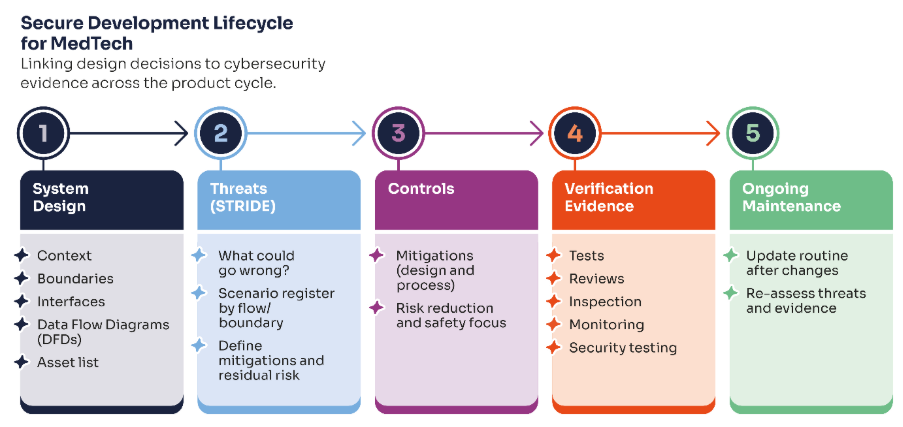
Software Developement Lifecycle for MedTech process flow

2. The SBOM that stopped at submission

A Software Bill of Materials is submitted as part of the conformity assessment or 510(k) package. It's accurate at that point. Then the product gets updated, libraries change, new dependencies come in, and the SBOM stays exactly as it was.

When Log4j was disclosed in late 2021, a critical vulnerability in one of the most widely used software libraries in existence, manufacturers without a maintained SBOM spent weeks in manual investigation trying to work out whether their devices were affected. Those with an automated, release-tied SBOM could answer that question in minutes.

The regulatory consequence of a static SBOM isn’t just a documentation gap. It means your postmarket vulnerability monitoring is compromised. Under both EU MDR and FDA Section 524B, the SBOM obligation applies throughout the product lifecycle, not just at the point of submission.

The fix is a process change more than a documentation effort:

  • SBOMs should be generated automatically at each build or release
  • SBOMs should be linked to a CVE monitoring workflow
  • Triage decisions must be documented: “we assessed this CVE, here is our conclusion and why”

One worked example of detection → assessment → decision → closure is worth more to a reviewer than a perfect SBOM last touched eighteen months ago.

3. The patch policy that couldn't survive clinical reality

A manufacturer writes a patch policy with timelines that look credible. It gets submitted. Then postmarket reality arrives. Medical devices in clinical settings are not consumer apps.

A critical patch may require a full regression test cycle before deployment because a software update that introduces instability is itself a patient safety risk. Devices may be in air-gapped environments. Hospitals have their own change control processes. High-uptime requirements limit the availability of maintenance windows.

None of this is unusual. All of it is foreseeable. But if the policy says 14 days and the deployment took 45, that’s a finding even when the delay was clinically justified and sensible.

The answer isn’t to write a weaker policy. It’s to write an honest one. Define severity tiers. Map them to how your devices actually get deployed. Include a documented exception process. A realistic policy you can consistently deliver is always more defensible than an impressive one you’ve already missed.

4. The outsourced developer who didn't know the rules applied

A large proportion of early-stage MedTech products are built by external development teams. Development teams build to specification. If security requirements weren't in the specification, the developers produced exactly what was asked for. No one failed. There's also no usable regulatory evidence.

More practically, if the contract didn’t require the developer to produce an SBOM, there may be no mechanism to get one. If security testing wasn’t a contracted deliverable, it may not have happened. Going back to a developer after the product is built to ask for evidence that wasn’t part of the agreement is an expensive conversation with an uncertain outcome.

This is entirely preventable at the contract stage. Security requirements, evidence deliverables, SBOM obligations, vulnerability disclosure procedures, and audit access rights must be in the contract before a single line of code is written. Once the product is built and the relationship has moved on, retrofitting these obligations is slow, costly, and sometimes impossible.

How the frameworks actually catch you

The non-conformity that lands on your desk usually isn’t “you failed to meet a regulatory requirement.” It’s “you told us you’d do X, and you didn’t.”

That distinction is important. It means the exposure often doesn’t come from a gap in your security. It comes from a commitment you made in a document, sometimes months earlier, possibly written to sound credible rather than to reflect operational reality that you then couldn’t keep.

Most compliance frameworks work this way

Put Simply

Think of a building inspection. The inspector doesn't just check the building against a universal rulebook. They check it against the plans you submitted. If your plans said the fire door would be at the end of the corridor, but it isn't, that's a finding, even if the building is otherwise safe.

In MedTech cybersecurity, your QMS documents and your submission materials are your plans. Whatever you wrote in them is what you're measured against. Write something ambitious that you can't deliver, and you've created the non-conformity yourself before the auditor arrives.

EU MDR: “timely” is the only number you’ll find

EU MDR does not prescribe specific patch timelines. The approach is deliberately non-prescriptive the expectation is that you understand your device, your deployment context, and your risk profile, and that you manage security in a way that’s proportionate to that. The obligations sit inside the General Safety and Performance Requirements GSPR 17.2 (state-of-the-art lifecycle, including information security) and GSPR 17.4 (minimum IT and security requirements for safe operation). The primary cybersecurity guidance document, MDCG 2019-16, calls for “timely” security patch updates. That’s it. No days, no severity tiers, no mandatory cadence.

What the EU MDR does have is a QMS requirement. Whatever you document in that quality management system becomes the standard you’re audited against. If your procedures say critical vulnerabilities will be patched within 14 days, 14 days is now your obligation. Miss it even once, even for a well-documented reason, and you have a non-conformity.

A manufacturer who wrote an ambitious patch policy to look credible during conformity assessment has created a much harder problem for their postmarket team. We’ve seen this. It’s an avoidable problem.

FDA Section 524B: two tiers, your numbers

The US framework under Section 524B creates two explicit tiers:

  1. Known unacceptable vulnerabilities: address on a “reasonably justified regular cycle”
  2. Critical vulnerabilities causing uncontrolled risk: address “as soon as possible out of cycle”

Neither tier contains a specific number of days. What Section 524B requires is that you state your timelines in the premarket submission, and those stated timelines become part of the basis on which the FDA assesses “reasonable assurance of cybersecurity.” FDA’s 2025 updated final guidance also addresses expectations around vulnerability communication and coordinated response timelines, though the specific requirements depend on device type and context, and manufacturers should refer directly to the current guidance for their situation.

The pattern we see: manufacturers state timelines that sound rigorous in a submission document but don’t reflect the realities of clinical deployment. What gets written in the submission is what gets measured postmarket. Those aren’t the same thing, and the gap between them is where findings come from.

DTAC: not a single timeline, but a framework that bites

DTAC doesn’t prescribe patch timelines either. What it requires is evidence of a credible, maintained security posture, including Cyber Essentials certification, penetration testing evidence, and alignment with the DSIT Software Security Code of Practice.

Cyber Essentials is where teams sometimes create their own problem. CE Plus carries implicit expectations for promptly addressing high-severity vulnerabilities, and a 14-day figure is quoted in various places and treated as the DTAC standard. It isn’t, or at least not universally. What “timely” means in practice under DTAC depends on the vulnerability, the device, the deployment environment, and, critically, what your documented policy actually says and justifies.

This is one of those areas where a short conversation before you write the policy saves a long and expensive conversation after you’ve committed to something you can’t keep. Pinning yourself to 14 days because you’ve seen that number somewhere, without thinking through whether your deployment reality actually supports it, is the kind of thing that generates findings. A defensible, risk-proportionate policy that reflects your actual environment is worth far more to an NHS trust than an impressive number you’ve already missed.

The same mistake, across all three frameworks

A manufacturer committed to patching critical vulnerabilities within 14 days. A critical patch came in. In practice, their hospital deployments required full regression testing before any software update could go out, a clinical safety requirement, not a shortcut. Actual deployment took 45 days. Their policy said 14. Their patch log said 45.

That mismatch, not their intentions and not even the patch itself, was the non-conformity.

What recovery actually looks like

When a non-conformity arises from a notified body, an FDA reviewer, or an NHS assessor, the first thing to understand is that it isn’t necessarily fatal. But it does have to be handled correctly, and the window for doing that is tighter than most teams expect.

Findings are categorised, and the category determines your options.

  • Major findings represent a systemic issue with potential patient safety impact. Certification cannot proceed until they’re resolved. Response windows vary by notified body and framework, but they are typically tight with limited opportunity to iterate, which means you need to structure recovery from day one, not day thirty.
  • Minor findings must be corrected within defined timescales, but don’t block certification. What catches teams out is the consequences of a minor finding recurring in consecutive audits. If the root cause wasn’t genuinely addressed, repeat findings get upgraded. That’s how a manageable situation becomes a serious one.

Recovery in practice: four stages

1. Triage the finding accurately
Work out exactly what was cited and, more importantly, whether you have a documentation gap or a genuine security control gap. These are different problems with different timelines and different costs. A documentation gap where the security work was done but never evidenced is faster to close than a control gap, where the measure genuinely wasn't in place. Confusing the two wastes time that you don't have.
2. Reconstruct or build the evidence chain
For documentation gaps, work backwards through the threat model, mitigation, requirement, and verification chain to produce the evidence that should have been there from the start. For control gaps: implement the missing measure, verify it, and produce evidence of both.
3. Produce a credible corrective action plan
The reviewer needs to see not just that the specific gap has been closed, but that you've understood why it happened and changed something to stop it happening again. A structured corrective action with a genuine root cause analysis lands very differently from a one-line response. Reviewers who do this regularly can tell the difference immediately.
4. Build what prevents the next one
Closing the current NCR is necessary. It isn't sufficient. The artefacts that get you through recovery include: a maintained SBOM, a release-tied evidence index, and a patch policy that reflects deployment reality. These are also the artefacts that mean your next audit goes differently.

We’ve run this process with companies that came to us after findings had already arrived. The lesson that comes up every time: the gap between security that exists in the product and security that exists in the documentation is almost always closable. But it takes structured, methodical work by someone who understands what the reviewer needs to see, not just what good security looks like.

What you build so you don’t go back

Episode 1 of this series introduced the Security Evidence Pack as the core structural answer. In the specific context of non-conformity prevention, four things matter most:

1. Your threat model needs to reflect your current product
A threat model written for an earlier version of the product, or developed without reference to the actual architecture, gives reviewers nothing they can trace forward to the controls in the current release. Version it. Update it when the product changes. It's a maintained document, not a one-time deliverable.
2. Your SBOM needs to be a workflow output, not a document
Generated automatically at each release. Linked to a CVE monitoring workflow. Updated triage log showing decisions made on material vulnerabilities. This is what postmarket surveillance obligations under EU MDR and FDA Section 524B require in practice and it's also what makes a security incident manageable rather than a crisis.
3. Your patch policy needs to reflect what you can actually deliver
Define severity tiers. Map them to your deployment constraints. Include an exception process. Review it before you commit to it in a submission or QMS document, because once it's written down, it's the standard.
4. Your evidence needs to be release-tied
A penetration test scoped to a system boundary that no longer reflects your current architecture, or a risk register last reviewed before your last major release, creates findings even when the underlying security is sound. Every artefact should clearly reference the product version it covers.

Free download: 10 Core Procurement Artefacts

This is the checklist we use to keep procurement and assurance work from becoming a last-minute scramble. It covers the ten artefacts most frequently requested across DTAC, EU MDR, and private procurement, including security architecture, threat model, SBOM and vulnerability monitoring, VDP/PSIRT route, patch policy, and incident response playbook, plus a suggested cadence for keeping them current.

Download the bifold PDF

Next step: Book a joint review

If you’ve received cybersecurity or clinical evidence-related findings and need to close them, or if you’re approaching an audit and want an honest view of where your evidence stands, book a joint review with Cyber Alchemy and Mantra Systems.

In 30 minutes we’ll:

  1. Assess where your current cybersecurity and clinical evidence stand against the framework you’re targeting
  2. Identify the gaps most likely to generate findings
  3. Give you a clear view of what to fix now, what to defer, and what a realistic recovery plan looks like

Book a joint Cyber Alchemy × Mantra Systems review

FAQs

What is a cybersecurity non-conformity under EU MDR?

A finding raised by a notified body indicating that your cybersecurity documentation or controls don’t meet Annex I GSPR requirements or, more commonly, that they don’t meet the commitments you made in your own QMS or technical documentation. Major findings must be resolved before certification can be issued or maintained.

Does EU MDR specify patch timelines?

No. MDCG 2019-16 requires “timely” updates which is the full extent of the prescription. The binding timelines are the ones you document in your QMS. Whatever you commit to becomes the standard you’re audited against.

Does FDA Section 524B specify patch timelines?

It specifies two tiers a “reasonably justified regular cycle” for known unacceptable vulnerabilities, and “as soon as possible out of cycle” for critical vulnerabilities causing uncontrolled risk, but neither contains a specific number of days. You state your own timelines in the premarket submission, and those become your obligation. FDA’s 2025 final guidance addresses vulnerability communication expectations in more detail, and manufacturers should refer to the current guidance for their specific device context.

Does DTAC require specific patch timelines?

DTAC itself doesn’t prescribe timelines. Cyber Essentials, which DTAC requires, carries implicit patching expectations, but specific figures sometimes quoted are not universal standards and need to be interpreted against your device type, deployment environment, and what your documented policy says. Getting this right before committing to it in writing matters.

Can cybersecurity nonconformities be recovered from?

Yes, but the recovery has a specific shape, and the window is typically tight. The key is understanding whether the gap is a documentation problem or a genuine control gap, and producing a corrective action that addresses the root cause rather than just the specific finding.

What’s the most common root cause of cybersecurity NCRs?

In our experience, there is a gap between the security that exists in the product and the security that exists in the documentation. The evidence chain from threat → control → verification → release-tied evidence is the thing most commonly missing and the thing reviewers most consistently look for.

The best time to build your cybersecurity evidence pack was before submission. The second-best time is before the finding lands.

About the authors

Neil Richardson, Co-Founder, Cyber Alchemy

Neil co-founded Cyber Alchemy and has over 15 years of experience in cyber security consultancy, technical assurance, and strategic advisory. Following the successful exit of his previous cybersecurity company in 2022, he now focuses on vCISO support, security strategy, and helping organisations take a pragmatic, business-aligned approach to cyber risk.

His background includes penetration testing, incident response, ISO 27001, and security consultancy across a wide range of sectors, including Medical Technology and Financial Technology. Neil also co-founded SteelCon, the ethical hacking conference, in 2012 and brings experience from the university sector, alongside a long track record of helping organisations improve resilience and security maturity.

Luke Hill, Senior Security Consultant, Cyber Alchemy
Luke brings deep expertise in security consultancy, penetration testing and regulatory-aligned security for the Health and Social Care sector. He leads Cyber Alchemy's technical and regulatory efforts in the MedTech space, supporting a broad range of MedTech companies in building resilient devices and applications that comply with complex UK, US, and EU regulations.

Case study: See how Cyber Alchemy supported Adaptix

Episode 1 from Mantra Systems
Where to Launch First? A MedTech Founder's Regulatory Roadmap to the EU, UK and US
Episode 1 from Cyber Alchemy
EU MDR & NHS DTAC Cybersecurity Requirements for UK Market Entry
Episode 2 from Mantra Systems
How to handle non-conformities and get back on track
Episode 2 from Cyber Alchemy
EU MDR, FDA 510(k) and DTAC Cybersecurity Nonconformities: How to Recover

Related articles

  1. Stopping the collapse of dominoes by placing finger on a red risk dominoe.

    Understanding Risk Management for SaMD

    Practical guidance on SaMD risk management under EU MDR — from component-level hazard identification to Post-Market Surveillance and ISO 14971 traceability.

    Megan Allen Megan Allen Regulatory Medical Writer
  2. A concerned medical device software developer considering the complexities of regulatory compliance

    Avoiding slow SaMD approval: A guide to faster market entry

    Most SaMD developers make avoidable mistakes that add months to approval. Here's what they are and how to sidestep them.

    Paul Hercock Paul Hercock CEO & Founder
  3. US and EU flag signposts pointing in different directions

    Top 5 mistakes US manufacturers make when entering the EU market

    Expanding into the EU market? Discover the five most common regulatory mistakes U.S. medical device manufacturers make — and how to avoid them.

    Aastha Kothari Aastha Kothari Regulatory Medical Writer
  4. Turning blocks from crosses to ticks

    How to handle non-conformities and get back on track

    A practical guide to understanding why non-conformities happen, the most common issues in medical device submissions, and how to resolve them efficiently to get you back on track.

    Dr Will Brambley Dr Will Brambley Lead Medical Writer
  5. US and EU flags on poles alongside each other.

    Clinical Evidence under EU MDR: Leveraging FDA Clinical Data to Streamline EU MDR Compliance

    FDA clearance alone is not sufficient for European market access - a theme we explore futher in this article and the accompanying webinar.

    Chandini Valiya Kizhakkeveetil Chandini Valiya Kizhakkeveetil Regulatory Medical Writer
  6. 3 people in an office in front of a whiteboard with the words 'Medical Device Market Entry Strategy' written above a world map.

    EU MDR & NHS DTAC Cybersecurity Requirements for UK Market Entry

    This guest article shows you how to build cybersecurity evidence for the EU MDR and NHS DTAC.

    Luke Hill Luke Hill Co-Founder of Cyber Alchemy
  7. An illustration showing a GPS-driven navigation route superimposed upon someone using a laptop.

    Where to Launch First? A MedTech Founder's Regulatory Roadmap to the EU, UK and US

    All three markets operate under different regulatory systems and place different demands on manufacturers.

    Ronghe Xu Ronghe Xu Regulatory Medical Writer & Strategic BD Lead China
  8. A woman uses an inhaler.

    Navigating EU MDR Article 117: A Practical Guide to Drug-Device Combination Product Submissions

    Implementation of the EU MDR 2017/745 has brought significant changes.

    Chandini Valiya Kizhakkeveetil Chandini Valiya Kizhakkeveetil Regulatory Medical Writer
  9. Collage art showing a pair of binoculars, an analogy for surveillance.

    How EU MDR Post Market Surveillance differs from FDA post-market expectations

    EU MDR and FDA post-market obligations aren't as similar as you might think. Here's what manufacturers need to know.

    Dr Gayle Buchel Dr Gayle Buchel Chief Medical Writer
  10. An arrow arcs from the US over to Europe.

    How EU device classification differs from the US - Are you prepared?

    Did you know an FDA Class II medical device could be immediately considered as a high-risk Class III device under European Union regulations?

    Gabriela Cardoso Gabriela Cardoso Regulatory Medical Writer
  11. A magnifying glass inspecting a number of wooden cubes with question marks upon them laid upon a blue table. The wooden cube under the magnifying glass has a lightbulb painted on it.

    Fixing the MDR and IVDR? The Commission’s Proposed Amendments and What They Mean for Manufacturers

    Exploring the key elements of this proposal.

    Chandini Valiya Kizhakkeveetil Chandini Valiya Kizhakkeveetil Regulatory Medical Writer
  12. Two arms point at a sign and hold a question mark, in an abstract pop-art style.

    Regulatory Reset? The EU’s Proposed Changes to MDR and IVDR Explained

    Changes published in December 2025 aim to streamline EU medical device and in vitro diagnostics. We explain who is impacted and how.

    Dr Gayle Buchel Dr Gayle Buchel Chief Medical Writer
  13. A pair of glasses rests on an eye test chart.

    Did You Know Your Glasses Were a Medical Device? A Regulatory Guide for Manufacturers

    The importance of correct classification and our recommended path to avoid common ophthalmic device 'gotchas'.

    Gabriela Cardoso Gabriela Cardoso Regulatory Medical Writer
  14. A precariously balanced pile of ping-pong balls and wooden bars.

    The Shift from MDD to MDR: Key Differences in Demonstrating Equivalence

    This transition has demanded that device safety must be demonstrated with more evidence. We offer tips for winning equivalence claims.

    Kamiya Crabtree Kamiya Crabtree Regulatory Medical Writer
  15. Holding up the Mantra Systems sign with Shanghai as a backdrop.

    2025: A year in review

    Our CEO takes a seasonal look back at our year in medical device regulation. Plus a peek at some of our offerings planned for 2026.

    Paul Hercock Paul Hercock CEO & Founder
  16. A pen and notepad, resting on a laptop.

    Periodic Safety Update Report: Requirements under EU MDR

    Post-Market Surveillance has become more stringent. We help you to understand what manufacturers need to consider.

    Chandini Valiya Kizhakkeveetil Chandini Valiya Kizhakkeveetil Regulatory Medical Writer
  17. An EU flag on a pole flies between two US flags against a blue sky.


    Webinar: From USA to Europe - Accelerating Your Path to the Medical Device Market

    We showed you how to quickly transform your U.S. regulatory work into a compliant EU MDR submission.

    Chandini Valiya Kizhakkeveetil Chandini Valiya Kizhakkeveetil Regulatory Medical Writer
  18. A poster frame for our Clinical Evaluation video series featuring Paul Hercock.

    Guide to Clinical Evaluation: Common Pitfalls & Useful Resources

    Part 5 - In the final video from this series, we explore five major pitfalls that often derail clinical evaluations.

    Paul Hercock Paul Hercock CEO & Founder
  19. A US-style 'changes ahead' warning road sign.

    Device Modifications: When a Simple Change Becomes a Regulatory Nightmare

    As regulatory consultants we understand how minor modifications to a device can often cause disproportionate disruption.

    Kamiya Crabtree Kamiya Crabtree Regulatory Medical Writer
  20. Webinar announcement poster.

    Webinar: Regulatory & Cybersecurity Essentials for medical device software and AI-enabled devices

    Our webinar with Cyber Alchemy addressed bringing AI-enabled medical devices to market with both the right regulatory and cybersecurity foundations.

    Shen May Khoo Shen May Khoo Regulatory Project Lead
  21. A simple jigsaw with iconography representing growth printed on it.

    Leveraging Post-Market Surveillance Data for Continuous Improvement

    PMS isn’t just about compliance, it’s an opportunity for improvement, enhance patient safety & innovate.

    Shen May Khoo Shen May Khoo Regulatory Project Lead
  22. A poster frame for our Clinical Evaluation video series featuring Dr. W. Brambley.

    Guide to Clinical Evaluation: CEP Strategy & CER Structure

    Part 4 - We explore how these guide reviewers through the evidence that supports safey, performance, and conformity.

    Dr Will Brambley Dr Will Brambley Lead Medical Writer
  23. A checklist being ticket-off in pen.

    The Critical Role of Pre-Submission Reviews in EU MDR Clinical Evaluations

    Ensuring your CER is robust and aligned with current standards is critical. How much Clinical Evidence is enough?

    Sandra Gopinath Sandra Gopinath Chief Regulatory Officer
  24. A poster frame for our Clinical Evaluation video series featuring Dr. W. Brambley.

    Guide to Clinical Evaluation: The State-of-the-Art (SOTA) Literature Review

    Part 3 - This is core of a sucessful submission. Will demystifies the process and explains how it supports clinical evaluation.

    Dr Will Brambley Dr Will Brambley Lead Medical Writer
  25. An orange tabletop with wooden question mark blocks laid upon it.

    Regulatory Update: EU Borderline & Classification Manual for medical devices v4

    New examples sharpen the distinction between medical devices and other product categories, such as pharmacologically active substances and aesthetic-only products.

    Chandini Valiya Kizhakkeveetil Chandini Valiya Kizhakkeveetil Regulatory Medical Writer
  26. A poster frame for our Clinical Evaluation video series featuring Dr. P. Boxall.

    Guide to Clinical Evaluation: Clinical Evaluation in Context

    Part 2 - A clinical evaluation demonstrates that a device is safe and effective, but achieving this requires more than simply compiling studies.

    Dr Peter Boxall Dr Peter Boxall Lead Medical Writer
  27. A poster frame for our Clinical Evaluation video series featuring Dr. P. Hercock.

    Introducing Our Guide to Clinical Evaluation Video Series: Building Strong Submissions Under MDR

    First of a five-part series of step-by-step guides.

    Paul Hercock Paul Hercock CEO & Founder
  28. A digitally generated image of a checklist being completed on a laptop computer.

    Maximise your success with our Clinical Evaluation pre-submission check

    We’re announcing the launch of a new service designed to help you with CER, CEP, and SOTA documentation – ensuring that documents meet Notified Body expectations and accelerating your route to market.

    Shona Richardson PhD Shona Richardson PhD Regulatory Project Lead
  29. Webinar announcement poster.

    Regulatory Strategy Essentials for Digital Health: Key Takeaways from Our Webinar

    We showed how to accelerate your runway to market through actionable steps that will shave months off your route to regulatory approval.

    Dr Peter Boxall Dr Peter Boxall Lead Medical Writer
  30. A laptop projects an alert to a user sitting at a desk.

    Vigilance & Incident Reporting: Everything You Need to Know

    Navigating the Complexities and Ensuring Patient Safety in Medical Devices.

    Gabriela Cardoso Gabriela Cardoso Regulatory Medical Writer
  31. An EU and US flag lying together.

    Achieving EU MDR approval when you are cleared under FDA

    Our guide to navigating the transition from FDA clearance to EU market access.

    Chandini Valiya Kizhakkeveetil Chandini Valiya Kizhakkeveetil Regulatory Medical Writer
  32. Some binocular-hand eyes as an analogy for surveillance.

    Post-Market Surveillance (PMS): Understanding PMCF & Vigilance under the EU MDR

    These serve distinct purposes and have different methodologies under the MDR framework. We breakdown each.

    Ronghe Xu Ronghe Xu Regulatory Medical Writer & Strategic BD Lead China
  33. A vision testing device.

    Implementing Master UDI-DIs: Key Insights from MDCG 2025-7

    Grouping devices with design similarities under a common Eudamed ID could unify them under a single master UDI-DI

    Dr Will Brambley Dr Will Brambley Lead Medical Writer
  34. A person studying at a desk with pad and paper.

    In the World of Regulatory Writing: 5 Lessons Learned

    Let’s break down some key lessons learned from the writing process and share practical tips to navigate them with clarity (and your sanity) intact.

    Kamiya Crabtree Kamiya Crabtree Regulatory Medical Writer
  35. Poster frame for video with Sue Kemp.

    Do you have the clinical evidence you need to support regulatory approval?

    Sue Kemp makes the case for implementing clinical strategy from day one.

    Paul Hercock Paul Hercock CEO & Founder
  36. An actual conventional UK passport.

    A New Era for NHS Innovation: ‘Innovator Passports’

    A digital fast-track system aims to transform how new medical technologies are adopted across the NHS, cutting red tape and accelerating access to medtech.

    Kamiya Crabtree Kamiya Crabtree Regulatory Medical Writer
  37. LinkedIn live webinar poster.

    From Idea to Approval: Get MDR Ready With Our LinkedIn Live

    An upcoming LinkedIn Live session with Dr. Zhong Wei Khor tailored specifically for healthtech founders.

    Paul Hercock Paul Hercock CEO & Founder
  38. A man crosses a high-wire across a forest.

    The Never-Ending Document Updates: Navigating Changing Regulations

    Just because you’ve submitted a document, it doesn’t mean the work is done. Clinical Evaluation Reports, Risk Management Files or PMS plans will all need updating.

    Kamiya Crabtree Kamiya Crabtree Regulatory Medical Writer
  39. A judges gavel sat infront of a Union Jack flag.

    UK Medical Device Regulations Set for Major 2026 Update

    The UK government is preparing to introduce a second major update to the regulatory framework for medical devices, with new pre-market requirements expected to come into effect in 2026.

    Dr Simon Cumiskey Dr Simon Cumiskey Senior Lead Medical Writer
  40. Video poster frame for Episode 3 of our series.

    Clinical Evaluation Masterclass: It is not clear that any systematic search methods were used for the literature review – Episode 3

    Addressing non-conformities isn’t just about avoiding negative outcomes; it’s about building a robust, evidence-based foundation.

    Paul Hercock Paul Hercock CEO & Founder
  41. A woman writes notes at her desk.

    Regulatory Writing Deadlines: The Pressure to Get It Right the First Time

    Anyone who’s worked in the medical device industry knows that regulatory deadlines aren’t just part of the process—they define it.

    Kamiya Crabtree Kamiya Crabtree Regulatory Medical Writer
  42. Medical phone software being used to communicate with a monitor placed on a mans skin.

    IEC 62366-1:2015 Demystified – Essential Usability Testing for Medical Devices

    What should be included in a Usability Engineering File? What steps do you need to take to ensure compliance and meet standards?

    Kamiya Crabtree Kamiya Crabtree Regulatory Medical Writer
  43. Video poster frame for Episode 2 of our ongoing series.

    Clinical Evaluation Masterclass: Appraisal of literature sources has not been conducted properly - Episode 2

    Our ongoing series covers one of the most frequent reasons for CER rejection: a poor appraisal of literature sources.

    Paul Hercock Paul Hercock CEO & Founder
  44. A lone figure navigates a rocky coastline.

    Navigating CAPA Terminology: Key Terms for Medical Device Professionals

    We define and explain the language required to work within a Quality Management System (QMS).

    Kamiya Crabtree Kamiya Crabtree Regulatory Medical Writer
  45. Video poster frame for Episode 1 of our new series.

    Clinical Evaluation Masterclass: Overcoming Non-conformities - Episode 1

    In this series, we work step-by-step through common Non-Conformities to ensure you are always ahead of possible challenges on the way to MDR approval.

    Paul Hercock Paul Hercock CEO & Founder
  46. A man carefully steps across a cliff-face. An analogy for assessing risk.

    Top 5 Common Pitfalls to Avoid During Risk Assessment

    Learn how to sidestep costly mistakes which manufacturers commonly make. From hazard ID to post-market surveillance, we help you improve safety and speed up approvals.

    Kamiya Crabtree Kamiya Crabtree Regulatory Medical Writer
  47. A label maker printing bar-code labels.

    Labelling 101: A Comprehensive Overview for Medical Device Manufacturers

    Labelling and packaging are critical elements to ensuring safety, compliance, and ease of use.

    Kamiya Crabtree Kamiya Crabtree Regulatory Medical Writer
  48. An illustration of a brain-shaped object on an abstract background.

    European Commission Guidelines on Prohibited Artificial Intelligence Practices

    Summary of the 8 AI practices prohibited by the EU 2024/1689 artificial intelligence (AI) Act.

    Dr Clare Dixon Dr Clare Dixon Regulatory Specialist
  49. A compass being used to navigate across mountainous countryside.

    Navigating Non-Conformities in Technical Documentation

    We explore how to manage non-conformities effectively and implement Corrective and Preventive Actions (CAPAs).

    Kamiya Crabtree Kamiya Crabtree Regulatory Medical Writer
  50. A photograph of a literal maze that we're using as a clever metaphor.

    Mastering the EU MDR: Essential Steps for Compliance-Ready Docs

    If you're uncertain about the readiness of your EU MDR documentation, this article provides an overview of the essential steps to ensure you’re on track.

    Kamiya Crabtree Kamiya Crabtree Regulatory Medical Writer
  51. An illustration showing scientists at work.

    A Guide to Electronic Instructions for Use (eIFU)

    Electronic Instructions for Use (eIFUs) are set to revolutionise how medical device instructions are delivered. We explore what this means for you.

    Dr Will Brambley Dr Will Brambley Lead Medical Writer
  52. Two helicopters look as if they are about to collide: An analogy for risk.

    Navigating Risk Management Requirements under the EU MDR

    This is a cornerstone of EU MDR 2017/745, requiring a continuous, well-documented approach. We unpack key requirements and provide actionable strategies.

    Dr Peter Boxall Dr Peter Boxall Lead Medical Writer
  53. A doctor operates a tablet computer.

    Beyond the Acronyms: Understanding SaMD and SiMD

    As software advancements continue, the line between traditional hardware-centric medical devices and software-driven solutions becomes increasingly blurred.

    Kamiya Crabtree Kamiya Crabtree Regulatory Medical Writer
  54. A team of profesional-looking people sit around a table, congratulating themselves.

    Extending the Validity of your IVDD Certificates – Key Dates

    The EU and the MHRA have extended the validity of IVDD certificates, allowing you more time to transition to the IVDR. We explain what this means for manufacturers.

    Kamiya Crabtree Kamiya Crabtree Regulatory Medical Writer
  55. A team of profesional-looking people sit around a table, congratulating themselves.

    GSPR 1: A New Era of Performance with Safety at the Core

    This regulation emphasizes risk management, durable design & biocompatibility to ensure medical devices are safe and effective. GSPR 1 protects users while driving innovation in medical technology.

    Kamiya Crabtree Kamiya Crabtree Regulatory Medical Writer
  56. Cybersecurity Vulnerabilities in Medical Devices: FDA Alerts on Contec and Epsimed Monitors

    Patients can be exposed to risks when devices are online. We explore implications for EU MDR/IVDR cybersecurity requirements, including MDCG guidance

    Dr Clare Dixon Dr Clare Dixon Regulatory Specialist
  57. A futuristic-looking factory full of labelled cardboard boxes.

    Decoding UDI: Your Ultimate Guide to Smarter Medical Device Labelling

    The Unique Device Identifier (UDI) ensures medical device traceability and compliance. We break down its structure, Device Identifier (UDI-DI), Production Identifier (UDI-PI) and its role in EUDAMED.

    Kamiya Crabtree Kamiya Crabtree Regulatory Medical Writer

  58. A hospital room full of equipment with futuristic user interfaces.

    IMDRF Sets the Standard: 10 Key Principles for AI-enabled Medical Devices

    Good Machine Learning Practice (GMLP) principles ensure safe devices, covering intended use, clinical evaluation & Human-AI Interaction (HAII).

    Ron Sangal Ron Sangal Lead Medical Writer
  59. A medical team discuss performance data at their desktop computer.

    Key Updates for Navigating EMDN: MDCG 2024-2 Rev.1 & 2021-12 Rev.1

    Release of the updated guidance helps manufacturers navigate the EMDN system for accurate device classification, ensuring market access.

    Ron Sangal Ron Sangal Lead Medical Writer
  60. A dated monitor for medical equipment.

    Understanding Clinical Evidence Requirements with MDCG 2020-6

    How can manufacturers ensure legacy devices meet MDR's stringent requirements? Discover how MDCG 2020-6 guidance simplifies the path to compliance.

    Dr Clare Dixon Dr Clare Dixon Regulatory Specialist
  61. A stethoscope laid on a desk of regulatory documentation.

    Clinical benefits of an in vitro diagnostic medical device

    How to determine the clinical benefit of an IVD and successfully incorporate it into regulatory documentation.

    Dr Gayle Buchel Dr Gayle Buchel Chief Medical Writer
  62. EU flags

    Regulation (EU) 2024/1860 - Its impact on EU MDR and IVDR

    How does the recent Regulation (EU) 2024/1860 amendment affect the EU MDR & IVDR?

    Shona Richardson PhD Shona Richardson PhD Regulatory Project Lead
  63. EU flag

    MDCG 2024-10 - Orphan medical devices

    How to apply MDR pre-market clinical evidence requirements to medical devices intended for limited usage.

    Dr Simon Cumiskey Dr Simon Cumiskey Senior Lead Medical Writer
  64. Considering a medical device's intended purpose

    A medical device's intended purpose - what is the point?

    How do you define intended purpose, indication for use, intended clinical benefits, and claims?

    Dr Simon Cumiskey Dr Simon Cumiskey Senior Lead Medical Writer
  65. Mantra Systems presents EnableChat, your AI-powered MDR & MDCG chatbot

    EnableChat - Your AI-powered MDR and MDCG chatbot

    Search the MDR and MDCG documents in seconds by asking EnableChat your questions.

    Dr Simon Cumiskey Dr Simon Cumiskey Senior Lead Medical Writer
  66. Searching adverse event databases for vigilance data

    Staying vigilant - A guide to searching for adverse events data

    We discuss the pros and cons of existing adverse event databases for vigilance data searching.

    Dr Simon Cumiskey Dr Simon Cumiskey Senior Lead Medical Writer
  67. A doctor reading an SSCP document with a patient

    What is Summary of Safety and Clinical Performance (SSCP)?

    We explain what the SSCP is, when you'll need it and what its objectives are.

    Sandra Gopinath Sandra Gopinath Chief Regulatory Officer
  68. A pile of question marks

    Medical Device 'Significant Changes' – Navigating EU MDR Article 120(3) using MDCG 2020-3 rev. 1

    Understand what changes to your medical device are considered 'significant' under EU MDR (2017/745).

    Shen May Khoo Shen May Khoo Regulatory Project Lead
  69. A signpost giving unsure directions

    MDR or IVDR - A sibling rivalry?

    A guide to easily understanding whether your device is a medical device or an in vitro diagnostic medical device (IVD).

    Dr Gayle Buchel Dr Gayle Buchel Chief Medical Writer
  70. An EU and UK flag

    What the latest Brexit U-turn means for CE Marking of medical devices in Great Britain

    Will Great Britain continue to allow the use of the CE mark for medical devices beyond the 2024 deadline?

    Dr Hanna Gul Dr Hanna Gul Lead Medical Writer
  71. A woman writing her own medical device regulation documentation

    Gain confidence, reassurance and control over your EU MDR strategy

    Find out how to build your own technical files within a guided framework while minimising financial outlays.

    Dr Gayle Buchel Dr Gayle Buchel Chief Medical Writer
  72. Racing to achieve MDR compliance

    Still racing to achieve MDR compliance? A transition period update

    On January 6th 2023, the EU commission has adopted the proposal to extend the transition rules of the EU MDR.

    Sandra Gopinath Sandra Gopinath Chief Regulatory Officer
  73. A 7-step guide to navigating regulatory requirements for medical device start-ups

    A medical device regulations guide for start-up companies

    We present a 7-step guide to navigating regulatory requirements on a budget.

    Paul Hercock Paul Hercock CEO & Founder
  74. An update on UKCA Marking of Medical Devices

    UKCA Marking of Medical Devices – An update on the status quo

    We review recently updated requirements for UKCA marking and what it means for your regulatory strategy.

    Dr Hanna Gul Dr Hanna Gul Lead Medical Writer
  75. How to choose a CER writer for your MDR Clinical Evaluation

    Choosing a CER writer for your MDR Clinical Evaluations

    We've compiled a list of considerations that will help you make the right choice when choosing a CER writer.

    Paul Hercock Paul Hercock CEO & Founder
  76. Achieving MDR Compliance for Class I medical devices

    How to achieve MDR Compliance for Class I medical devices

    We outline a strategy for the regulatory compliance of Class I medical devices.

    Sandra Gopinath Sandra Gopinath Chief Regulatory Officer
  77. Literature Search, SOTA Review and Clinical Evaluation

    Literature Search, SOTA Review process and Clinical Evaluation

    We help to demystify the process of systematic search & review of literature for Clinical Evaluation.

    Sandra Gopinath Sandra Gopinath Chief Regulatory Officer
  78. Literature Search Protocols & SOTA Reviews for medical devices and what to know before you start

    Literature searches and reviews for medical devices - what to know before you start

    We explain what you should know before beginning a literature search & review for your medical device.

    Sandra Gopinath Sandra Gopinath Chief Regulatory Officer
  79. Five useful resources when writing a medical device CER

    Five useful resources when writing a medical device CER

    We outline five of the most useful and trustworthy Clinical Evaluation Report writing resources.

    Victoria Cartwright Victoria Cartwright Relationship Manager
  80. Avoid pitfalls when writing a Clinical Evaluation Report

    Five common pitfalls when writing a Clinical Evaluation Report

    We illustrate five pitfalls when writing CERs and give you some tips to overcome them.

    Paul Hercock Paul Hercock CEO & Founder
  81. How to make a medical device equivalence claim under the MDR

    Five tips for making a medical device equivalence claim under the MDR

    We'll show you what to keep in mind with regards to equivalance and Clinical Evaluation.

    Sandra Gopinath Sandra Gopinath Chief Regulatory Officer
  82. Keeping medical devices in market and maintaining CE-marks - a guide to effective data collection

    Keeping medical devices in market and maintaining CE-marks

    The 4 golden rules to drive regulatory compliance with PMCF and vigilance data collection.

    Paul Hercock Paul Hercock CEO & Founder
  83. How PMCF goes beyond simple compliance - improving products and engaging customers

    How PMCF goes beyond simple compliance

    The wider benefits of a well-designed PMCF system include improving your products and your relationship with your clients.

    Paul Hercock Paul Hercock CEO & Founder
  84. PMCF systems for medical devices

    Why you'll almost certainly need a PMCF system for your medical devices

    We tell you what to be aware of under the EU MDR regarding PMCF and your medical devices.

    Paul Hercock Paul Hercock CEO & Founder
  85. Ensure medical device regulatory compliance of your devices through Brexit

    The impact of Brexit on medical device regulatory compliance

    How to ensure regulatory alignment of your devices in the territories affected by Brexit.

    Paul Hercock Paul Hercock CEO & Founder
  86. Use medical device regulatory consulting services to supercharge your MDR transition

    Is outside consulting support the answer to your MDR transition?

    Getting ready for the MDR is a demanding process. Outsourcing might be your solution.

    Paul Hercock Paul Hercock CEO & Founder
  87. Increasing data entry compliance in PMCF studies

    Increasing data entry compliance in PMCF studies

    5 methods every medical device manufacturer should know to improve their Post-Market Clinical Follow-up studies.

    Paul Hercock Paul Hercock CEO & Founder
  88. Why medical doctors can drive MDR compliance

    Why medical doctors can drive MDR compliance

    Working with the MDR requires knowing how to work with clinical evidence. Medical doctors are perfectly positioned to meet this requirement.

    Victoria Cartwright Victoria Cartwright Relationship Manager
  89. Software as a Medical Device

    Software as a Medical Device

    Unless you have spent time working with medical device legislation in the past, the idea that software could be a medical device may be rather unexpected.

    Paul Hercock Paul Hercock CEO & Founder
  90. clinical investigator for pmcf eu mdr compliance

    Ensuring that clinical investigations work in practice

    How can medical device manufacturers ensure valid clinical investigations when access to medical expertise remains limited?

    Paul Hercock Paul Hercock CEO & Founder
  91. Coronavirus and medical device regulations

    Relaxing medical device regulatory requirements during a healthcare crisis

    During the coronavirus pandemic, how far should we go when relaxing medical device regulatory requirements?

    Paul Hercock Paul Hercock CEO & Founder
  92. The new MDR compliance challenge

    The new MDR compliance challenge

    Across the industry, medical device companies are facing challenges in meeting the demands of the new Medical Device Regulations (MDR) 2017/745 framework.

    Paul Hercock Paul Hercock CEO & Founder
  93. Sources of Real World Evidence for MDR compliance

    Sources of Real World Evidence for MDR compliance

    At Mantra Systems our objective is to make sure that our clients choose the method of real world data harvesting that is right for them.

    Paul Hercock Paul Hercock CEO & Founder

More articles

Need help producing compliant CEPs & CERs? We are offering FREE CEPs to 5 qualifying applicants per week

Get your free CEP